NEWS SUMMARY:
- Volvo Trucks has unveiled two new 13-litre engines which deliver more power, lower fuel consumption and reduced emissions
- Both new engines can be used with diesel and alternative fuels, including bio-LNG, biodiesel, HVO and hydrogen
- The engines cater for a wide variety of applications, and meet or exceed new emissions and noise-related legislation
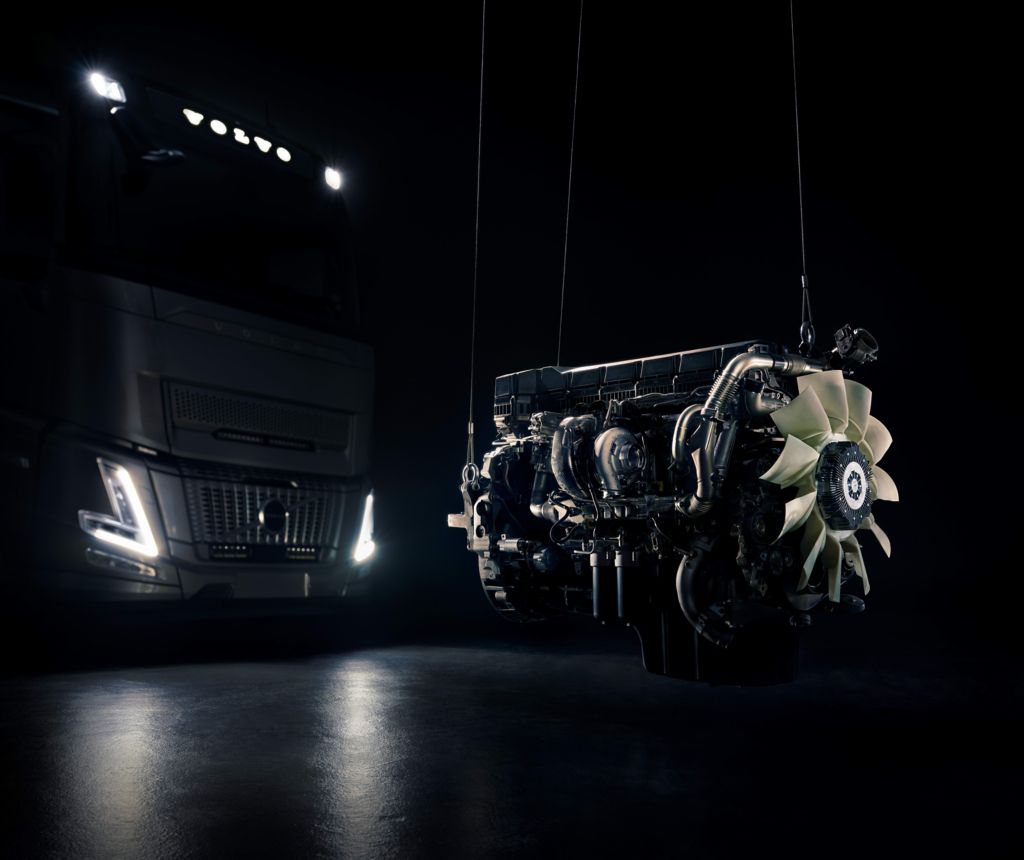
The combustion engine continues to play an important role in Volvo Trucks’ driveline strategy and its latest products offer an attractive combination of more power with reduced fuel consumption, lower emissions, less noise and improved drivability.
The new engine can deliver up to 4%* lower fuel consumption versus its predecessor when combined with Volvo Trucks’ latest fuel-saving innovations, which will now become available to more customers.
An all-new global combustion engine platform
Volvo Trucks has developed the new engines to cater for a wide variety of needs and conditions while also meeting or exceeding the requirements of new emissions- and noise-related legislation.
“These all-new engines are not only our most fuel-efficient powertrains ever, but they will also take our combustion engine into the future,” says Jan Hjelmgren, Head of Product Management at Volvo Trucks.
“The flexibility and readiness for all existing diesel and gas fuels, and also future hydrogen applications, means that we can offer efficient trucks with the possibility of net-zero emissions to all our customers globally.”
New technologies for fuel efficiency and fuel flexibility
With a constant focus on improving fuel efficiency, Volvo Trucks has developed one of the cleanest engine generations available on the market.
In combination with the Volvo FH Aero range – which cuts fuel consumption by up to 5% compared with the standard model – the all-new in-house developed engines will deliver further fuel savings of up to 4% across a wide range of applications and segments.
The new platform comes with a refined engine brake functionality for increased drivability, new cylinder and turbo designs, as well as an updated version of Volvo’s I-Shift transmission. Both the diesel and gas versions will also offer significantly higher torque levels.
Many variants of the diesel version of the new engine are also compatible with Volvo Trucks’ I-Roll with engine stop/start functionality, which means that more customers can save fuel and cut emissions by being able to turn off the engine while driving downhill.
Volvo Trucks is accelerating its transition towards fossil-free transport to reach its net-zero emissions target by 2040 using a three-path technology strategy. The approach is built on battery electric, fuel cell electric and combustion engines that run on renewable fuels like green hydrogen, biogas (bio-LNG), biodiesel, and HVO (hydrotreated vegetable oil).
Volvo Trucks’ new combustion engines – facts:
- The new engine platform is ready for alternative fuels such as biodiesel/B100, HVO, biogas/bio-LNG and green hydrogen
- The D13 engine will come with 380-560 hp of power and 1,800-2,900 Nm of torque
- The G13 version has 420-500 hp and 2,400-2,800 Nm
- The new Euro 6 engines fulfil the NNR3 (New Noise Regulation Phase 3) legal requirements, and are also built for future legislations
- The engines will be offered in the Volvo FM, FMX, FH and FH Aero models
- Sales will begin during the third quarter of 2026
- The new engines will be launched step-by-step globally, with the first markets being Europe, Morocco, Turkey and India, later followed by North and Latin America, Asia and Africa
- They will initially be produced in Skövde, Sweden and the trucks are assembled in Tuve, Sweden and Ghent, Belgium
* Example based on simulations of a Volvo FH 500, operating at a gross combination weight of 35-tonnes, with the new D13 engine and use of Cruise Control, I-See and I-Roll with engine stop/start functionality, versus the previous standard D13 eSCR engine, in representative European driving conditions. Actual fuel consumption may vary depending on many factors i.e. driving speed, use of cruise control, vehicle specification, vehicle load, topography, the driver’s driving experience, vehicle maintenance, and weather conditions.